


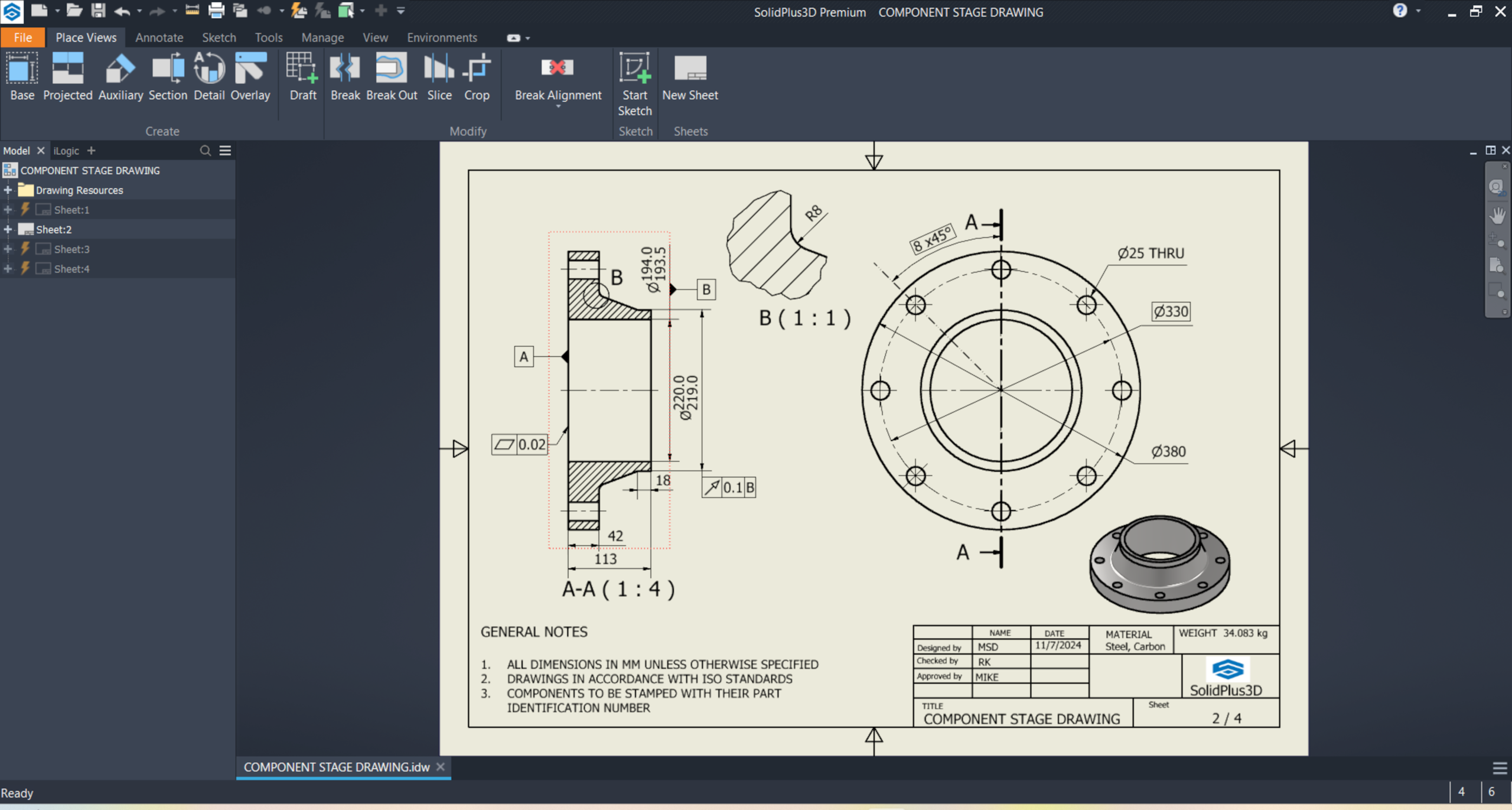
While 3D CAD models are the foundation of modern product development, manufacturing still depends heavily on accurate and detailed 2D engineering drawings. These drawings communicate critical information required for fabrication, machining, assembly, inspection, and quality control.
SolidPlus3D bridges the gap between design and manufacturing by providing powerful tools for generating professional, manufacturing-ready 2D drawings directly from 3D models.
Why 2D Drawings Still Matter
Despite advances in digital manufacturing, 2D drawings remain an essential part of engineering documentation.
Manufacturers rely on drawings to communicate:
Dimensions and tolerances
Manufacturing specifications
Assembly instructions
Welding requirements
Surface finish information
Inspection criteria
Material specifications
Accurate drawings ensure that everyone—from machinists and fabricators to quality inspectors and suppliers—works from the same engineering intent.
Automatically Generate Drawings from 3D Models
Creating drawings manually can be time-consuming and prone to errors.
SolidPlus3D automates the process by generating associative 2D drawings directly from 3D parts and assemblies.
Engineers can quickly create:
Part drawings
Assembly drawings
Fabrication drawings
Sheet metal drawings
Structural drawings
Manufacturing documentation
Because drawings remain linked to the 3D model, updates are automatically reflected whenever the design changes.
Comprehensive Drawing Views
SolidPlus3D supports a complete range of engineering drawing views required for manufacturing and documentation.
These include:
Standard orthographic views
Isometric views
Section views
Detail views
Auxiliary views
Exploded assembly views
Broken views
This enables engineers to clearly communicate even the most complex designs.
Intelligent Dimensioning and Annotation
Accurate dimensions and annotations are critical for manufacturing success.
SolidPlus3D provides tools for:
Smart dimensioning
Geometric tolerancing (GD&T)
Surface finish symbols
Weld symbols
Notes and callouts
Center marks and centerlines
These features help ensure drawings meet company and industry documentation standards.
Manufacturing-Ready Documentation
SolidPlus3D is designed to simplify the transition from engineering to production.
Engineers can automatically generate:
Bills of Materials (BOM)
Balloon annotations
Cut lists
Assembly instructions
Manufacturing notes
This reduces manual documentation effort while improving accuracy and consistency.
Fully Associative Drawing Environment
One of the biggest challenges in traditional drafting workflows is maintaining drawing accuracy after design changes.
SolidPlus3D eliminates this problem through full associativity.
When engineers modify:
Dimensions
Features
Assemblies
Components
The drawing updates automatically, ensuring documentation always matches the latest design.
Support for Industry Standards
Engineering teams often need to comply with customer, industry, or company-specific standards.
SolidPlus3D supports:
Custom title blocks
Drawing templates
Company standards
Dimensioning standards
Documentation formats
This allows organizations to maintain consistency across all engineering projects.
Seamless Export and Collaboration
Once drawings are complete, they can be easily shared with manufacturing teams, customers, and suppliers.
SolidPlus3D supports export formats including:
PDF
DWG
DXF
STEP
Industry-standard documentation formats
This ensures compatibility across the entire manufacturing ecosystem.
Applications Across Industries
2D drawings generated in SolidPlus3D are used across a wide range of industries, including:
Industrial machinery
Sheet metal fabrication
Structural engineering
Process equipment
Material handling systems
Automotive components
Manufacturing equipment
Consumer products
Whether designing a simple component or a complex assembly, engineers can create clear and professional manufacturing documentation efficiently.
Benefits of 2D Drawings in SolidPlus3D
Organizations using SolidPlus3D for engineering documentation benefit from:
Faster drawing creation
Reduced drafting effort
Improved documentation accuracy
Automatic update management
Better manufacturing communication
Lower risk of production errors
Faster project delivery
These advantages help engineering teams improve productivity while maintaining high-quality documentation standards.
Conclusion
Although 3D models drive modern product development, 2D engineering drawings remain the language of manufacturing. SolidPlus3D combines intelligent automation, associativity, and comprehensive detailing tools to help engineers create accurate, professional, and manufacturing-ready documentation with minimal effort.
By automating drawing creation and maintaining complete synchronization with the 3D model, SolidPlus3D enables organizations to move from design to production faster, more accurately, and with greater confidence.


Leave a Reply